


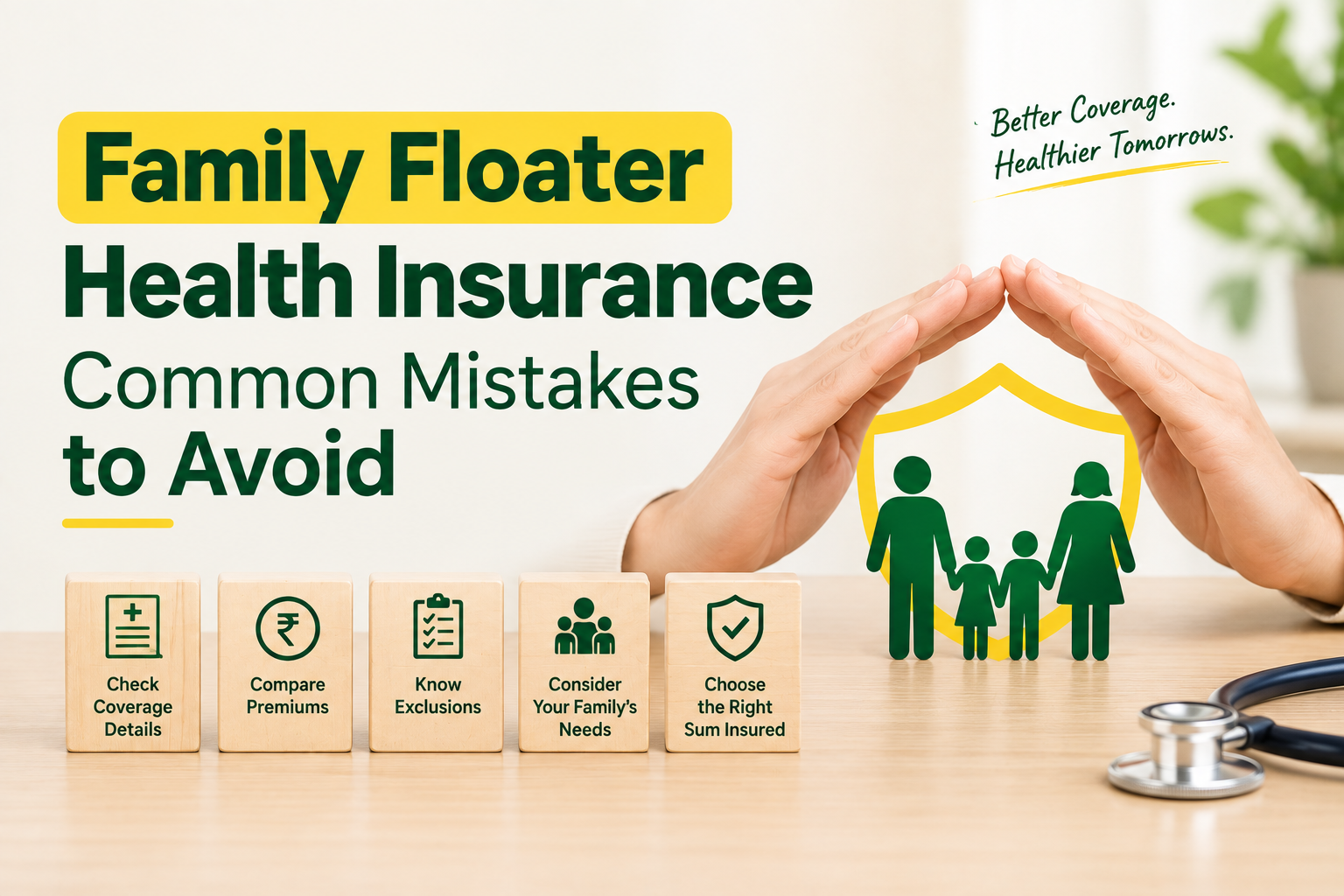
The most common mistakes with family floater health insurance include choosing an inadequate sum insured (often under ₹10–15 lakh despite 12–14% medical inflation), adding elderly parents to the shared pool, ignoring room-rent and disease sub-limits, skipping restoration benefits, selecting the cheapest plan without checking claim settlement ratios or network hospitals, and non-disclosure of pre-existing conditions. Avoid these by matching cover to real family needs (typically ₹15–25 lakh+ for a nuclear family in cities), keeping parents on separate senior plans, reading the fine print, and reviewing annually. This protects your family’s finances far better than a poorly structured policy.
Key Takeaways
- Medical inflation in India runs at 12–14% annually; a cover that felt enough five years ago is often inadequate today.
- Never add parents aged 60+ to a floater covering younger members—it inflates premiums and concentrates claim risk.
- Prioritise no room-rent caps, unlimited restoration, high claim settlement ratios (ideally 95%+), and wide cashless networks.
What Is Family Floater Health Insurance?
A family floater health insurance plan covers multiple eligible family members (usually self, spouse, and children) under a single shared sum insured. Any member can use the full amount, and the premium is generally lower than buying equivalent individual policies. Premiums are typically calculated on the age of the eldest member.
Benefits of a Well-Chosen Family Floater
- Cost efficiency for nuclear families compared with multiple individual policies.
- Simplified administration—one policy, one premium, one renewal date.
- Shared pool that can fully cover a major hospitalisation for any one member.
- Often includes no-claim bonuses that grow the sum insured over claim-free years.
- Easy addition of newborns (subject to insurer rules) and portability under IRDAI guidelines.
When structured correctly and paired with a super top-up, it forms one of the strongest pillars of family financial protection—alongside term insurance and other best safe investment options in India.
Common Mistakes to Avoid
1. Choosing an Insufficient Sum Insured
Many families still buy ₹5–10 lakh floaters. In Tier-1 cities a cardiac procedure or multi-day ICU stay can easily exceed that. Advisors now recommend a base of ₹15–25 lakh (or higher) for a family of four, with a super top-up layered on top for catastrophic protection.
2. Adding Elderly Parents to the Floater
This is among the most expensive and frequent errors. Premiums jump because pricing follows the oldest member. One major claim by a parent can exhaust the entire pool, leaving younger members unprotected. Better approach: separate senior-citizen or individual plans for parents aged 60+.
3 Selecting the Cheapest Plan
Low premiums often hide co-pays, high deductibles, long waiting periods, or weak hospital networks. Always compare claim settlement ratio (CSR), incurred claim ratio, complaint ratios, and cashless network density—especially for Health Insurance in Chandigarh where access to Fortis, Max, and similar hospitals is critical.
4. Relying Solely on Employer-Provided Cover
Corporate policies end with job change, layoff, or retirement and may have lower limits or restricted benefits. Treat them as a supplement, not the primary safety net.
5. Not Reviewing the Policy Document and Exclusions
Exclusions for cosmetic procedures, certain outpatient costs, specific waiting periods for maternity or listed illnesses, and consumables can surprise claimants. Read the policy wording and ask clarifying questions.
6. Failing to Review and Update Periodically
Family size, ages, city of residence, and medical needs change. Reassess sum insured, members covered, and features every 2–3 years or after major life events.
Expert Tips for Choosing the Right Family Floater
- Match the structure to risk profiles: nuclear family floater + separate senior plans for parents.
- Target no room-rent limit, no co-pay (or low co-pay), unlimited restoration, and strong no-claim bonus.
- Verify cashless network hospitals in your city and preferred hospitals.
- Check IRDAI-published claim settlement data and recent customer experience.
- Consider adding a super top-up for high-limit protection at modest extra cost.
- For residents of Chandigarh and the Tricity, consult a local Health insurance advisor near me in Chandigarh who understands regional hospital networks and can integrate coverage with broader financial investment and consultancy services.
Step-by-Step Guide to Buying or Reviewing a Family Floater
- List all members to be covered and note ages plus any known medical history.
- Decide structure: floater for nuclear family vs individual/senior plans for parents.
- Calculate required sum insured based on city, preferred hospital type, and medical inflation (aim ₹15–25 lakh base for most urban families of four).
- Shortlist 3–5 plans with no major sub-limits, high CSR, and strong restoration.
- Disclose all medical details accurately on the proposal form.
- Set calendar reminders for annual review and possible sum-insured increase.
- Keep digital and physical copies of policy, ID proofs, and medical records ready for claims.
Comparison Table: Family Floater vs Individual Policies (Illustrative 2026 Guidance)
| Aspect | Family Floater | Individual Policies | Best For |
|---|---|---|---|
| Sum Insured | Shared pool | Separate for each member | Floater: young healthy family |
| Premium | Usually lower overall | Higher total cost | Budget-conscious nuclear families |
| Claim Risk Concentration | High if one large claim occurs | Isolated to one member | Individual: mixed ages/chronic conditions |
| Parents 60+ | Generally avoid | Preferred | Separate senior plans |
| Restoration Importance | Critical | Helpful but less critical | Both, but essential for floaters |
| Administrative Ease | High | Lower | Floater when profiles are similar |
Actionable Checklist
- Exclude or separately cover parents aged 60+
- Verify no room-rent cap and no disease sub-limits
- Confirm unlimited or robust restoration benefit
- Check claim settlement ratio and local hospital network
- Disclose all pre-existing conditions fully
- Read exclusions, waiting periods, and co-pay clauses
- Schedule a policy review every 2–3 years
Conclusion
Family floater health insurance can be an excellent, cost-efficient way to protect your household—provided you avoid the common traps of under-insurance, poor member selection, hidden limits, and incomplete disclosure. In an environment of sustained double-digit medical inflation, the difference between a thoughtfully structured policy and a casually chosen one can mean the difference between financial resilience and severe strain during a health crisis.
Frequently Asked Questions
1. What is the biggest mistake people make with family floater health insurance?
Choosing too low a sum insured and/or adding elderly parents to the shared pool, both of which leave the family under-protected or facing sharp premium increases.
2. How much sum insured should a family of four buy in 2026?
Most advisors recommend a base of ₹15–25 lakh for urban families, often supplemented by a super top-up, given current hospital costs and medical inflation.
5. Are room-rent sub-limits still common?
Yes, especially in lower-premium plans. Prefer policies with no room-rent caps to avoid proportionate claim deductions.
6. Can I rely only on my employer’s health insurance?
No. Employer cover is valuable but temporary. Maintain an independent family floater or individual policies as the primary safety net.
7. How important is claim settlement ratio when choosing a plan?
Very. Look for consistently high CSR (ideally 95%+) along with a strong local hospital network and reasonable complaint ratios.
9. Is a family floater better than individual policies?
It depends. Floaters suit young, healthy nuclear families; individual or hybrid structures work better with age gaps or chronic conditions.